
Antitrust and Competition Law Training
Ensure employees recognize anticompetitive risks before they become costly violations.
Train. Reinforce. Protect.
Traliant Learning Topics pair foundational, attorney-authored training with reinforcement content, including Micro Reels that keep key concepts fresh throughout the year. Always protected, not more time in training.
Spot the warning signs
Most employees don't expect an everyday business conversation, trade association meeting or discussion with a competitor to create legal risk. Yet seemingly routine interactions can cross the line if employees don't recognize the warning signs.
Traliant's Antitrust and Competition Law Learning Topic helps employees recognize antitrust risks before they become violations. Through realistic workplace scenarios, learners build practical skills to identify prohibited business practices, make compliant decisions and know when to involve Legal.
To reinforce learning throughout the year, the course is complemented by 10 two-minute Antitrust Micro Reels that keep high-risk topics top of mind.
FOUNDATIONAL TRAINING
Antitrust and Competition Law
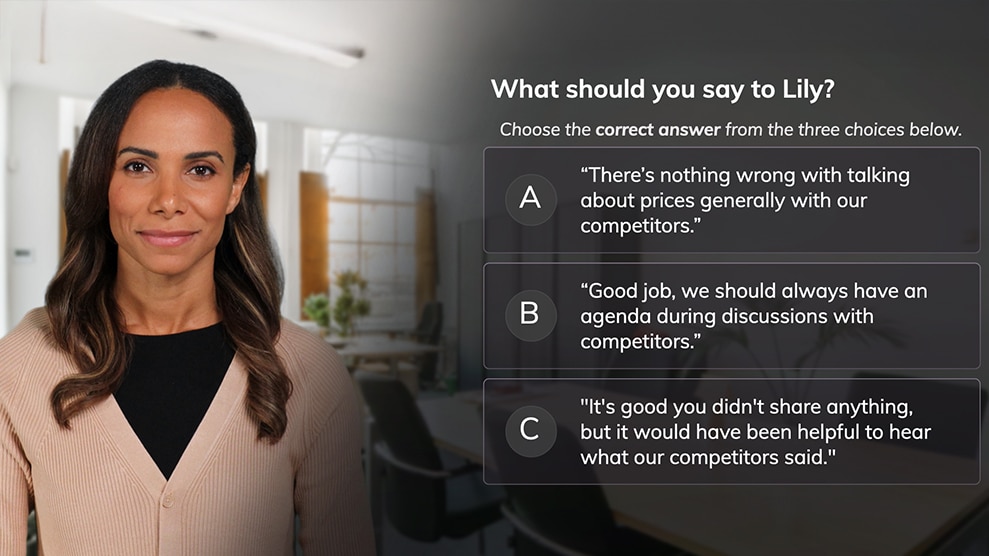
This Learning Topic covers:
- Overview of antitrust laws
- Monopolies
- Avoiding violations including bid rigging, no-poaching agreements, wage fixing and price fixing
- Prohibited practices
- Trade associations
- Supply chain vertical relationships
- Supply chain manufacturer requirements
- Penalties and punishments
ALWAYS-ON RISK MITIGATION
A stronger compliance program with the tools to go deeper, ready when you are.
What is a Learning Topic?
A Learning Topic is everything you need to cover one subject, like preventing harassment or keeping data safe. It’s more than a single course. It pairs attorney-authored training with reinforcement tools that keep the protection going after the course ends.
How does it work?
The full course meets your requirements, giving a documented, defensible record. Reinforcement tools keep that protection working between annual trainings. Pick your Learning Topic, roll it out, and it keeps working all year.
What’s in a Learning Topic?
Reinforcement tools vary by topic, so each Learning Topic includes the mix that fits its subject.

Foundational courses
Comprehensive training written by our in-house attorneys and kept current as laws change. Produced with the quality of a TV show, so it holds attention and the lesson sticks.

Micro Reels
Short, just-in-time videos that reinforce key concepts right when employees need them most.

Refreshers
Short follow-up courses that strengthen retention between annual trainings.

Application Tools and Job Aids
Practical resources that help employees apply what they learned with confidence on the job.
What to consider when choosing the most effective antitrust training

- Minimize legal and financial risks: Antitrust violations can result in significant fines and penalties for both companies and individuals. Training helps organizations to comply with antitrust laws and to protect themselves from these risks.
- Maintain a positive reputation: Antitrust violations can damage a company's reputation and erode trust with customers, partners, and investors. Training helps to create a culture of compliance and to protect the company's image.
- Promote a strong ethical culture: Training helps to ensure that employees understand the importance of fair competition and that they are committed to conducting business ethically.
- Empower employees: Training provides employees with the knowledge they need to understand antitrust laws and to make informed decisions about their business activities.
- Strengthen your organization's compliance program: A robust antitrust training program is an essential component of a strong compliance program, helping to mitigate legal and reputational risks.
- Promote a culture of compliance: Training helps to create a culture where employees understand that compliance with antitrust laws is essential and that they are expected to report any potential violations.
- The Sherman Act (1890): This law prohibits monopolies and other anticompetitive practices, such as price fixing, bid rigging, and market allocation agreements.
- The Clayton Act (1914): This law prohibits mergers that are likely to substantially lessen competition.
- The Federal Trade Commission Act (1914): This law created the Federal Trade Commission (FTC), which enforces antitrust laws and investigates anticompetitive business practices.
- The Robinson-Patman Act (1936): This law prohibits price discrimination, which is charging different prices to different buyers for the same product or service.
- Higher prices: Without competition, a monopolist can set higher prices, which can harm consumers.
- Reduced quality: A monopolist may have less incentive to innovate or to improve the quality of its products or services.
- Limited choice: Consumers may have fewer choices if there is only one company providing a particular product or service.
- Price fixing: Companies agree to set prices at a certain level, instead of competing on price.
- Bid rigging: Companies collude to manipulate bidding processes, ensuring that a particular company wins a contract.
- Market allocation: Companies agree to divide up a market among themselves, avoiding competition in certain areas.
- No-poaching agreements: Companies agree not to hire each other's employees, limiting competition for talent.
- Criminal penalties: Individuals can face fines and imprisonment.
- Civil penalties: Companies can face fines, and individuals can face civil penalties.
- Injunctions: Courts can issue injunctions that require companies to stop engaging in illegal behavior.
KEY FEATURES
Why you'll love our training
It’s time to embrace a new era of online training with a valued partner who will ensure seamless implementation, a truly enjoyable learning experience, and courses with continuous compliance you can trust.

Compliance expertise
Traliant's in-house legal expertise ensures training is accurate and kept up-to-date with any regulatory changes.

Accessible to users with disabilities
Traliant provides an inclusive experience for all users, including those with disabilities, by going beyond Section 508-C standards and offering WCAG 2.1/2.2 AA.

Story-based learning
Our story-based approach blends leading instructional design with Hollywood talent to produce engaging, interactive and nuanced training.

Administration
Traliant makes it simple to roll out training to your workplace and provide technical support directly to your employees at no additional cost.

Customizations
Tailor courses to include your logo, relevant policies, workplace images, and more. Traliant can even customize the course with scenarios that take place in your own workplace environment.

Translations
Training is available in English, Spanish and is supported in over 100 languages.
COMPLIANCE EXPERTISE
Your partner in training compliance

Uniquely qualified in-house compliance team
Our exceptional in-house Compliance Advisory Team is led by Michael Johnson, Chief Strategy Officer and former U.S. Department of Justice attorney who has provided training and guidance to organizations like the Equal Employment Opportunity Commission, Google, the United Nations, and the World Bank.

Keeping you compliant, effortlessly
Keeping up with the complex web of employment laws — especially if your workforce spans multiple states — can be tricky. That’s why we offer a streamlined training solution that ensures you stay compliant with federal, state, and local regulations, so you can focus on what matters most: your team.

Simplifying your policies and handbooks
Crafting an employee handbook that meets legal standards can be daunting. Let us ease the burden. We help you navigate regulatory changes to ensure your policies and handbooks not only comply with the law but also reflect industry best practices.