Forklift General Awareness Training Course
Providing forklift operators and pedestrians with practical forklift safety training minimizes the risk of accidents and injuries to drivers and those around them.
Train. Reinforce. Protect.
Traliant Learning Topics pair foundational, attorney-authored training with reinforcement content, including Micro Reels that keep key concepts fresh throughout the year. Always protected, not more time in training.
Course description
Traliant’s Forklift General Awareness training is a 35-minute course designed for employees and managers who operate powered industrial trucks (PIT), including forklifts, and those who work around them. The course introduces learners to the basics of safely operating and working around forklifts, including the different kinds of forklifts, how forklifts work, and common forklift hazards.
This course supports the formal instruction requirements of OSHA’s Powered Industrial Truck standard (29 CFR 1910.178). To meet OSHA’s full training requirements, employees must supplement this course with practical training and worksite-specific information.
ONLINE TRAINING
Forklift General Awareness Training Course
Forklift general awareness covers these topics and more:
- Powered Industrial Trucks (PIT); definition and overview
- Types of forklifts and common applications
- Differences between PITs and automobiles
- Employer training requirements, and benefits of training
- Pedestrian awareness and traffic management
- Safe operation on ramps and grades
- Hazards of operating a PIT in enclosed or hazardous areas
ALWAYS-ON RISK MITIGATION
A stronger compliance program with the tools to go deeper, ready when you are.
What is a Learning Topic?
A Learning Topic is everything you need to cover one subject, like preventing harassment or keeping data safe. It’s more than a single course. It pairs attorney-authored training with reinforcement tools that keep the protection going after the course ends.
How does it work?
The full course meets your requirements, giving a documented, defensible record. Reinforcement tools keep that protection working between annual trainings. Pick your Learning Topic, roll it out, and it keeps working all year.
What’s in a Learning Topic?
Reinforcement tools vary by topic, so each Learning Topic includes the mix that fits its subject.

Foundational courses
Comprehensive training written by our in-house attorneys and kept current as laws change. Produced with the quality of a TV show, so it holds attention and the lesson sticks.

Micro Reels
Short, just-in-time videos that reinforce key concepts right when employees need them most.

Refreshers
Short follow-up courses that strengthen retention between annual trainings.

Application Tools and Job Aids
Practical resources that help employees apply what they learned with confidence on the job.
What to consider when choosing the most effective forklift awareness training

- Prevent accidents and injuries: Forklifts can be dangerous machines if they are not operated safely. Training helps to reduce the risk of accidents and injuries by ensuring that both operators and pedestrians are aware of the hazards.
- Create a safer workplace: Training helps to create a safer workplace environment for everyone.
- Comply with OSHA regulations: The Occupational Safety and Health Administration (OSHA) mandates forklift training for operators. Awareness training can complement OSHA's requirements and enhance the overall safety program.
- Empower employees: Training provides employees with the knowledge and skills they need to operate forklifts safely or to work safely around them.
- Strengthen your organization's commitment to safety: Training demonstrates the company's commitment to creating a safe working environment.
- Reduce the risk of accidents, injuries, and property damage: Training helps to minimize the risk of forklift accidents, which can result in injuries to operators, pedestrians, and damage to property.
- Tip-overs: Forklifts can tip over if they are overloaded, driven too fast, or operated on uneven surfaces.
- Collisions: Forklifts can collide with pedestrians, other vehicles, or objects.
- Falling loads: Loads can fall from forklifts if they are not properly secured.
- Pedestrian hazards: Pedestrians can be struck by forklifts if they are not aware of the forklift's movements.
- Wear a seatbelt: Always wear a seatbelt when operating a forklift.
- Inspect the forklift before use: Check the forklift for any damage or defects before operating it.
- Operate at a safe speed: Obey speed limits and adjust your speed based on conditions.
- Use caution on ramps and grades: Slow down and be extra cautious when operating on ramps or grades.
- Be aware of pedestrians: Always be aware of pedestrians and other vehicles in the area.
- Be aware of their surroundings: Pay attention to the movements of forklifts.
- Maintain a safe distance: Stay clear of forklifts, especially when they are in operation.
- Make eye contact with the operator: Before crossing a forklift's path, make eye contact with the operator to ensure they see you.
- Wear high-visibility clothing: Wear high-visibility clothing to make yourself more visible to forklift operators.
- OSHA requirements: Forklift operator training is mandated by OSHA. Training must include both theoretical and practical components.
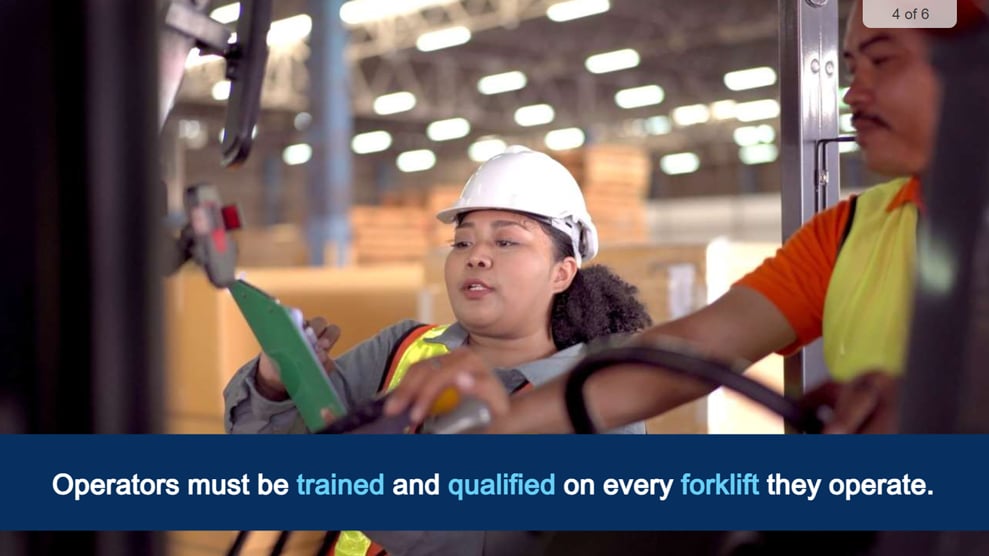
- Specific forklift types: Training should be specific to the type of forklift that the operator will be using.
- Workplace-specific hazards: Training should address the specific hazards present in the workplace, such as narrow aisles, uneven surfaces, and pedestrian traffic.
KEY FEATURES
Why you'll love our training
It’s time to embrace a new era of online training with a valued partner who will ensure seamless implementation, along with a learning experience your employees will truly enjoy.

Course administration
Traliant makes it simple to roll out training to your workplace and provide technical support directly to your employees at no additional cost.

Course customizations
Tailor courses to include your logo, relevant policies, workplace images, and more. Traliant can even customize the course with scenarios that take place in your own workplace environment.

Translations
Training is available in English, Spanish and is supported in over 100 languages.